

The tractor transformed farming. John Deere, Henry Ford, and International Harvester offer three unique historical case studies from the fascinating era that introduced power farming.
Power farming emerged in the early twentieth century, driven by the introduction of the farm tractor as a supplement to, and then replacement for, the horse. What role did strategy play in the tractor’s development and adoption? Of course, by asking the question, you already know the answer—strategy was the North Star, at least for the most successful companies, driving decisions that a century later might appear curious and misguided.


Behind the agricultural industry’s early twentieth century transformation was hundreds of entrepreneurs and companies driving innovative new machines and farm practices. Some survived, though most did not. Century-old companies disappeared, and hungry entrepreneurs flush with investment capital soon learned that farm machinery was not a get-rich-quick industry. Leaders in steam engine technology worked to adapt to the emerging trends in gasoline and kerosene traction engines, where early leaders like the Hart-Parr Company of Charles City, Iowa and the Avery Co. of Peoria, Illinois, fought to keep their early edge. But by the 1930s there were only a handful of companies left, consolidated and merged into seven full-line agricultural equipment manufacturers. (The term full-line was inside talk for building everything for the farm). For some, farm equipment was only a division of a larger business.
What set the survivors apart? Historically, of course, we have the ability to look back at the why and the how. Of particular interest are three of the companies that emerged during this era: John Deere, Henry Ford & Son, and International Harvester. The three companies executed differentiated approaches, each unique to where they were starting, where they wanted to go, and leveraging the resources at their disposal. Here’s a strategy snapshot from each company as they worked to design, build, introduce, and evolve the farm tractor.
John Deere
After the consolidation and acquisition of approximately ten companies from 1910-1912, as well as the erection of a new factory to build harvesting equipment solely to compete against long-time segment leader International Harvester, Deere had little capital to spare. Yet, in 1912, the company resolved to build a farm tractor. They were meticulous in their investigation, benchmarking the operations of partners and market leaders, attending field trials, and developing a diverse variety of tractors of the one-cylinder, two-cylinder, and four-cylinder variety. John Deere had little room for error, and knew they had to get it right. A few key areas of focus drove Deere’s eventual acquisition of the Waterloo Gasoline Engine Company in 1918:


- Strategic criteria were established up front. Understanding these criteria explains most of Deere’s decisions over the next six years, with some room for pivoting along the way.
- Internal research and development and years of market research put Deere in a position to act quickly on their acquisition of the Waterloo Gasoline Engine Company.
- Constant re-evaluation and market study. The early industry moved quickly, transitioning from steam to large gasoline prairie tractors to what one publication called the “gorgeous nightmare period,” the dawn of the small, more affordable tractor for the average sized farm.
- Patience. Deere leadership knew it could not compete, at least initially, with market leader International Harvester, and that Henry Ford, if he finally entered the market as he promised in 1908, would win market share through economies of scale and price. Deere’s strategy, then, was based on its strengths as an implement manufacturer (they all had to be redesigned for the tractor), its ability to form strong partnerships (with their competitors even), and its ability to evolve the machine form to fill emerging segments.
- Service. Deere leadership determined that building and selling tractors could not be separated from service and repair after the sale. A focus on dealer training was in place before the Waterloo Boy was sold under the John Deere name.
International Harvester
Harvester was a global, diversified company with a “full line” of agricultural equipment, and an ambitious plan for extensions into automobiles and farm tractors. It was the market leader by ten-times heading into the 1910s, and dominated the most profitable equipment line, harvesting equipment. International Harvester operated the largest agricultural equipment sales channel in the United States, and was focused on building capacity and machines that could operate in different crops and different parts of the world. The company also had two overarching brands and two separate dealer networks to satisfy. Some features of its strategy included:
- Commitment to the machine form. From an early stage, Harvester was committed to the tractor business, and was committed to its development and commercial adoption.
- Dual branded lineup. International Harvester was formed in 1902 by the consolidation of four companies, most prominently McCormick and Deering (not to be mistaken with Deere!). Independent lines for McCormick and Deering dealerships were created under the Titan and Mogul tractor names, and early design and development occurred independently at multiple, existing factories.
- Combining internal research and development with outsourced, off-the-shelf components until internal competencies and expertise was achieved.
- Constant, field proven innovation. Harvester’s product line evolved in real-time by introducing small production runs at different size and horsepower levels. Harvester continuously designed new iterations of their products, thoroughly tested them with customers, and evolved the line each year with the awareness that each farm was unique.
- Co-dependent development of farm implements. Harvester understood that farm implements had to be redesigned to work with farm tractors, allowing the company to leverage its leading position as a “full line” manufacturer.
- Perhaps most importantly, International Harvester was adept at rethinking and starting over. The Farmall tractor is a perfect example. “When we were building attachments to fit a tractor we were not getting anywhere in particular,” wrote advertising manager A.C. Seyfarth about early work on what became the Farmall tractor. “[B]ut when we started building a tractor to meet the requirements of the attachments, we began to forge ahead.”
Henry Ford & Son
Henry Ford’s ambition for his farm tractor were ultimately rooted in an altruistic movement, an effort to unburden farmers from the doldrums of their daily routine. His goals were simply different. From that foundation, repeated financial loss bore no consequence in the face of saving the world from starvation during World War I and delivering a tool that would give farmers independence and greater profitability. Ford’s tractor accelerated the industry, brought fierce competition and instability, but also drove innovation and evolution. The Ford strategy was an extension of Ford’s personality—visionary, deeply rooted in his childhood experiences, and unapologetic for anything that stood in the way of the final objective. Ford’s path was purely his own.

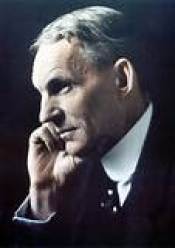
- Disruption, disruption, disruption. Ford grew up on the farm, and understood the impact the tractor could have on a farmer’s operation. He knew he was fighting generations of tradition. Ford disregarded industry traditions and conventions, and sought only to bring his product to as many people as he could. That meant building more and selling it cheaper. He was not worried about the competition, because he was convinced his team had designed the perfect tractor.
- The Model T was the people’s car, and the Fordson would be the people’s tractor. Ford leveraged his automobile prowess to introduce and sell his farm tractor (the Fordson). Ford Motor Company shareholders were so opposed to the product that Ford had to create a separate company, which was never profitable. But profit was not his goal, giving him a competitive, although unsustainable, advantage.
- Like the Model T, the assembly line defined the Fordson tractor. It facilitated mass production and an inexpensive retail price. When sales fell, Ford dropped the price, pushing the losses on his automobile dealers, many of which objected to tractor sales from the start.
- Henry Ford leveraged government contracts, first with the British government in the midst of World War I, then with state governments in the United States at the end of the war. American farmers were willing to wait because they trusted wholeheartedly that Henry Ford was looking out for their best interests.
- One size fit all. There were minor variations and improvements over the years, but Fordson customers essentially all bought the same tractor. Over time, as customer needs evolved, the tractor no longer served their needs. The Ford tractor became a case study in emergence, dominance, and demise.
Just the Beginning
Hindsight is 20/20, and in the race to introduce the farm tractor, there were hundreds of brands vying for position in the first two decades of the twentieth century. In the case of John Deere, International Harvester, and Henry Ford, each company offers a fascinating case study into strategy and execution. And no, you cannot deny the impact of diverse personalities, each tested by competition, world events, financing, and strategy. Yes, strategy. Although it’s easy to take history as predetermined or inevitable, that should never be the case. People, regardless of the time, are complex, passionate, and unpredictable, both in life and in business. And at the end of the day, people make decisions.
The farm tractor was not inevitable. In fact, like many technologies, the early years were fraught with market miscalculation, an underestimation of challenges, and a struggle to create an attractive value proposition in the face of an ever-evolving market. Three companies, in a congested field of more than 160 tractor manufacturers by the early 1920s, emerged as market leaders. Each approached the proposition in their own unique way, rooted in personal and corporate ideology, customer input, and so much more. Were they successful? I’m confident each company would have argued that they were successful—and already years into figuring out what was next based on their new strategy!